
When my daughter was finally acknowledged to have a learning disability, I was relieved she could finally get some help. I kept getting told she was normal, but I knew she was a lot further behind than my other two children were at her age.
A lot of people mistakenly believe dyslexia is just about backwards letters, but it is much more than that. I knew what to look for because my ex-husband is also dyslexic.

The problem is dyslexics learn to adapt, so it is difficult to tell if there is a problem. I remember trying to convince my daughter’s kindergarten and first grade teachers that she had books memorized and was not actually reading. That was one way she learned to adapt so her peers did not know she could not do what they could do.
Difficulty recognizing shapes.
My daughter could get some, but a lot she could not seem differentiating between.
Reading and writing were not just about the reversal of letters
They also involved repetitions, additions, transpositions, omissions, and substitutions of letters. Often a dyslexic will substitute a letter or letters that look similar to the letter they want to write.
Difficulty putting thoughts into words
They speak in halting phrases, leave sentences incomplete, stutter under stress, mispronounce long words, or transpose phrases, words, and syllables when speaking. My daughter consistently said “by accidently” rather than “by accident” or “accidently”. Her father makes similar verbal faux pas.
Trouble with writing or copying.
Rewriting a word was often a struggle for both my husband and my daughter, even if the word was right in front of them.
Computing math shows dependence on finger counting and other tricks.
My daughter’s teachers were constantly complaining that she did not have her math facts memorized.
Can do arithmetic but fails word problems.
Word problem comprehension is a nightmare. I often had to rephrase word problems so that my daughter understood.
Poor memory for sequences, facts and information that has not been experienced.
When helping my daughter do book reports I had to literally ask her, “What happened first?” and “What happened after that?”
Had unusually early or late developmental stages
This includes talking, crawling, walking, and tying shoes. My daughter actually skipped crawling. She went from creeping straight into walking around 13 months.
Often complain of stomach aches or headaches to avoid going to school.
My daughter had a lot of stomach aches.
Difficulty learning nursery rhymes and rhyming in general.
My daughter just did not get that whole rhyming concept.
Difficulty comprehending rapid instructions and processing and understanding what he or she hears.
Whatever instructions she got had to be short mini-steps.
Trouble understanding jokes or expressions that have a meaning not easily understood from the specific words (idioms), such as “piece of cake” meaning “easy”. Everything is taken literally!
I knew we were past a major hurdle when she finally started understanding puns.
Word Blindness
 If you think there is something going on with your child, observe them. Keep a diary of those observations. Keep pushing both the school and your child’s pediatrician for answers. Don’t just let them tell you there is nothing wrong. Dyslexia is often known as word blindness. Graphic designer, Daniel Britton, created typefaces so that the non dyslexic can get a taste of what reading is like for a dyslexic.
There is Hope
 There is hope for the dyslexic. Researcher, Christian Boer, has created a free font called the dyslexie font which makes it easier to read and spell. It can be found here or here. There are also thousands of apps available through the internet.
The Children’s Dyslexia Center
Orton Gillingham Method
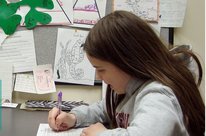 My daughter, pictured, was there three years. She had grown so much since beginning this venture. The center uses the Orton-Gillingham method which involves multi-sensory teaching. We traveled there twice a week for an hour of learning. The tutors volunteer and the funding is provided by the masons via fundraisers including pie sales, car washes and walks.
Statistics
“Dyslexia is an inherited neurological disorder that affects the way people learn to read and speak as well as how they process things mathematically. Dyslexia affects one out of every five people, and affects boys and girls in equal numbers. Children left with untreated dyslexia often suffer devastating personal consequences. It is the number one reason teenagers drop out of school, and is a primary factor in juvenile delinquency. Research reveals that children with untreated dyslexia can become underachieving adults unable to contribute to society at their fullest capacity.” Children’s Dyslexia Center
